The digital world is still changing rapidly in 2025, and cyber threats are no exception. Attackers are getting more skilled, stubborn, and opportunistic as organizations depend more on digital tools and services that work together online.
Current studies from Verizon’s 2025 Data Breach Investigations Report (DBIR) and IBM’s X-Force Threat Intelligence Index demonstrate how the type and severity of cyberthreats are changing.
The top five cyberthreats for 2025 are broken down below for everyone to be aware of, including businesses, governments, and individuals. These insights are useful for decision-makers in a variety of industries, not just IT teams.
You can take preventative measures to safeguard your data and operations by being aware of the risks.
1. Credential Theft
30% of cyber intrusions involved valid credentials (IBM X-Force).
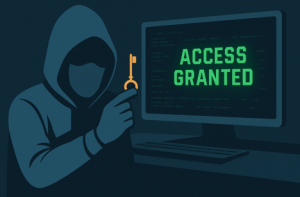
The biggest threat in 2025 is not someone breaking into your systems, it is someone logging in with real usernames and passwords. It is like a thief walking through your front door with a spare key, instead of breaking a window, making intrusion go unnoticed until real damage is done.
According to IBM’s 2025 Threat Intelligence Index, 30% of all cyber intrusions involved attackers using valid credentials. Instead of hacking in through complex code, they simply obtain passwords and log in like regular users. This method makes it much harder to detect.
Verizon’s DBIR also confirms the trend. Their data shows that the misuse of stolen credentials remains the top method of initial access in data breaches.
Even worse, there has been an increase in infostealer malware, which are programs made to gather login credentials. According to IBM, the number of phishing emails containing infostealers has increased by 84%.
Many compromised systems, according to Verizon, are personal devices used for work (“BYOD”), frequently storing both corporate and personal credentials.
What You Can Do:
- Use multi-factor authentication (MFA)
- Keep software updated
- Never reuse passwords across accounts.
2. Ransomware
44% of breaches involved ransomware
Now includes data theft and public extortion tactics
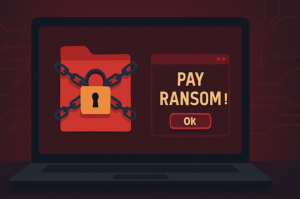
Ransomware is still the most common cyberthreat. By 2025, hackers are employing new techniques to extract money, so it’s not just about encrypting your files.
According to Verizon’s DBIR, ransomware was found in 44% of breaches this year, compared to 32% the previous year. Even if the files aren’t encrypted, IBM notes that ransomware attackers are now employing a variety of extortion strategies, including stealing data and threatening to make it public.
It’s interesting to note that although more businesses are declining to pay ransoms (64% in 2025 compared to 50% two years ago), the attacks themselves have become more disruptive and accurate. Particularly at risk are small businesses: Smaller businesses accounted for 88% of ransomware-related breaches.
Real world example: UChicago Medicine reported that data from 38,000 patients was exposed due to a third-party debt collector’s system breach. The data included names, addresses, medical details, and even financial account information. This type of incident demonstrates the devastating impact ransomware and third-party data handling failures can have on critical sectors like healthcare.
What you can do:
- Maintain regular backups
- Segment your network
- Conduct frequent employee training to recognize suspicious emails and links
3. Exploiting Unpatched Vulnerabilities
20% of breaches involved known but unpatched vulnerabilities (Verizon).
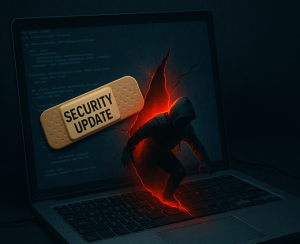
Another growing threat in 2025 is the exploitation of known but unpatched software vulnerabilities. These are weaknesses in software that should be fixed with updates, like regular security patches you get on windows and android, but often aren’t installed in time.
IBM and Verizon both report that many cyberattacks now start by targeting these security gaps. Verizon’s data shows that 20% of breaches were caused by vulnerability exploits, which is a 34% increase from the previous year.
Edge devices (hardware that connect directly to the internet, acting as a doorway between a company’s internal systems and the outside world, like routers) and virtual private networks (VPNs) were particularly common targets.
Even when patches are released, many organizations take too long to apply them. Verizon found that only 54% of vulnerable devices were fully patched, and the average time to do so was 32 days.
What you can do:
- Develop a patch management policy
- Prioritize updates for systems connected to the internet
4. Third Party and Supply Chain Attacks
Third-party-related breaches jumped from 15% to 30% (Verizon).
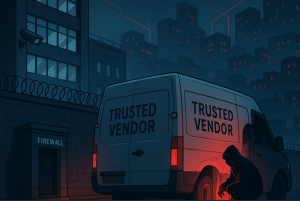
In an interconnected world, your security relies heavily on your partners. Third party breaches have increased from 15% to 30% in the past year, according to Verizon.
These attacks happen when cybercriminals compromise a vendor or software provider to reach their actual targets. For instance, IBM pointed out the Salt Typhoon attack, where a nation state group targeted major U.S. telecommunications providers and critical infrastructure through third party channels.
Another recent case involved Vanta, a compliance software company, where a bug exposed private customer data to other customers. While this incident wasn’t due to a cyberattack, it shows how mistakes in trusted platforms can still lead to leaks of sensitive information.
These incidents are particularly dangerous because they often slip past direct security measures. Attackers take advantage of the trust between companies and their vendors.
What you can do:
- Regularly check third-party access
- Require strong security policies from vendors
- Use monitoring tools to spot unusual activity
5. Misuse of Artificial Intelligence
AI-generated phishing emails doubled in last 2 years (Verizon).
14% of employees used company devices to access AI tools (Verizon).
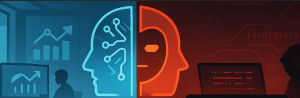
While artificial intelligence (AI) is revolutionizing our way of life and work, it is also altering the tactics used by attackers. According to IBM, threat actors are using generative AI to construct fake websites, write malicious code, and compose phishing emails. Verizon also notes that during the previous two years, the quantity of malicious emails created by AI has doubled.
Unintentional data leaks are another issue. According to Verizon, 14% of workers regularly used company devices to access AI tools. Many put sensitive data at risk by using unsecured channels or personal accounts.
Additionally, according to Cisco Talos, hackers are spreading malware that looks like artificial intelligence tools. Users have been tricked into downloading ransomware by fake AI installers, particularly in office settings where AI adoption is widespread.
What you can do:
- Educate employees on the risks of using AI tools and create policies for safe usage
- Monitor where and how AI is being accessed in your network
Conclusion
The cyber threat landscape in 2025 is influenced by advanced tactics and the growing overlap between personal and professional digital lives. Credential theft, ransomware, and unpatched vulnerabilities continue to pose major threats. Additionally, risks from third parties and misuse of AI present new challenges.
To stay ahead, a complete approach is necessary. This involves combining technology, policy, and human awareness. Insights from IBM and Verizon provide guidance not just for IT teams but for leaders in all industries.
Cybersecurity is no longer optional, it is essential.
Sources:
- IBM X-Force Threat Intelligence Index 2025
- Verizon 2025 Data Breach Investigations Report
Cisco Talos Threat Source Newsletter (2025)