Why the old model of vendor oversight is broken, what Gartner analysts say comes next, and how security leaders must prepare for an era of continuous risk intelligence


Today’s biggest cyber risk may not be inside your organisation at all it could be sitting somewhere in your supply chain.
As businesses become increasingly connected to cloud providers, SaaS platforms, MSPs, contractors, and other external partners, the attack surface continues to expand. Gartner estimates that organisations manage more than 1,500 third-party relationships on average, yet most still lack visibility into a large portion of their vendor ecosystem.
At the Gartner Security & Risk Management Summit 2026 in National Harbor, Maryland, analysts delivered a clear message: traditional vendor assessments can no longer keep pace with modern threats. The future of third-party risk management lies in continuous visibility, real-time intelligence, and resilience-driven decision-making.
What This Article Covers
- Why traditional Third-Party Risk Management (TPRM) is failing
- Key Gartner Summit 2026 insights on vendor risk
- Shift from annual assessments to continuous monitoring
- AI’s role in modern vendor risk management
- Growing risks from fourth-party supply chain dependencies
- Impact of regulations like NIS2, DORA, and SEC rules
- Future trends and best practices for CISOs
Why Third-Party Risk Has Become a Boardroom Issue

A.1 The End of Traditional Vendor Oversight
Third-party risk was once handled through annual assessments, compliance reviews, and contract clauses. Today, that approach is no longer enough. As businesses become increasingly dependent on external providers, supplier risk has evolved into a business-wide concern.
A.2 Growing Dependence on External Ecosystems
Cloud platforms, SaaS applications, managed services, and API-driven workflows have created highly interconnected ecosystems. While these partnerships improve efficiency, they also introduce new security, operational, and financial risks that often extend beyond an organisation’s direct visibility.
A.3 More Than a Cybersecurity Problem
A third-party incident can trigger regulatory scrutiny, financial losses, reputational damage, and operational disruption. In sectors such as healthcare, manufacturing, and logistics, a vendor outage or breach can directly impact critical business operations.
A.4 Why Boards Are Paying Attention
As the consequences of supplier failures grow, third-party risk is increasingly viewed as a business resilience issue rather than a security issue alone. Boards, regulators, and investors now expect organisations to actively understand, monitor, and manage risks across their extended supplier ecosystem.
The Current State of Third-Party Risk Management in 2026
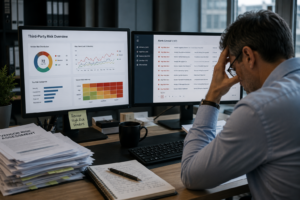
Despite growing awareness, most organisations still rely on a familiar vendor risk model: onboarding questionnaires, periodic compliance reviews, and annual audits. While security ratings and monitoring platforms have gained traction, they often serve as supplementary tools rather than core components of risk management.
The biggest challenge is visibility. Traditional assessments capture a vendor’s security posture at a single point in time, offering little insight into how risks evolve between reviews, how controls are maintained, or how supplier dependencies affect overall exposure.
At the same time, continuous monitoring has introduced a new problem: too much data and too little context. Security teams already overwhelmed by internal threats often struggle to prioritise and act on third-party risk alerts effectively.
Key Weaknesses in Today’s TPRM Model
- Point-in-time assessments leave long visibility gaps.
- Manual processes struggle to scale with growing vendor ecosystems.
- Compliance reviews measure documented controls, not real-world security performance.
- Risk scores often lack business context and prioritisation.
- Fourth-party and extended supply chain risks remain largely invisible.
- Vendor risk and incident response programmes are rarely well integrated.
At the Gartner Security & Risk Management Summit 2026, analysts argued that these challenges stem from flawed programme design rather than a lack of tools. Simply adding more monitoring technology does not solve third-party risk if governance, workflows, and risk management processes remain unchanged.
Key Gartner Summit Themes Shaping the Future of TPRM
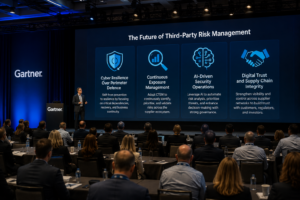
At the Gartner Security & Risk Management Summit 2026, third-party risk was not discussed as a standalone challenge. Instead, it emerged as a critical component of broader security, resilience, and trust strategies.
C.1 Cyber Resilience Over Perimeter Defence
Gartner emphasised a shift from prevention to resilience. For third-party risk programmes, this means focusing not only on preventing supplier-related incidents but also on understanding critical dependencies, recovery capabilities, and business continuity when disruptions occur.
C.2 Continuous Exposure Management
The growing adoption of Continuous Threat Exposure Management (CTEM) is reshaping vendor risk assessments. Rather than relying on periodic reviews, organisations are being encouraged to continuously identify, prioritise, and validate risks across their supplier ecosystem.
C.3 AI-Driven Security Operations
AI is increasingly being used to automate risk analysis, prioritise threats, and improve decision-making. However, Gartner analysts stressed that effective AI-driven risk management depends on strong governance, reliable data, and transparent oversight.
C.4 Digital Trust and Supply Chain Integrity
Supply chain security is becoming a key pillar of digital trust. Organisations are facing growing pressure from customers, regulators, and investors to demonstrate visibility and control across their supplier networks. Strong third-party risk management is increasingly viewed as both a resilience requirement and a business differentiator.
From Vendor Assessments to Continuous Risk Intelligence
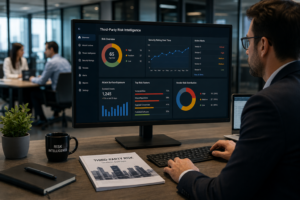
The future of third-party risk management lies in continuous risk intelligence, not annual vendor reviews. In a threat landscape where supplier compromises can emerge within hours, periodic assessments leave dangerous visibility gaps.
Modern TPRM programmes are increasingly built around continuous intelligence, including:
- Attack Surface Monitoring: Identifies exposed assets, vulnerabilities, and misconfigurations across vendor environments.
- Threat Intelligence: Provides visibility into active threats targeting vendors, industries, or technologies.
- Security Ratings: Tracks security posture over time, revealing whether risk levels are improving or deteriorating.
- Behavioral Indicators: Signals such as executive turnover, security staffing changes, exposed credentials, or unusual access activity can help identify elevated risk before an incident becomes public.
The objective is not to collect more vendor data, but to make faster, better-informed risk decisions. Organisations that successfully integrate these intelligence signals into governance and decision-making processes gain earlier visibility into emerging threats and greater resilience across their supplier ecosystem.
How Artificial Intelligence Is Transforming Third-Party Risk Management

Artificial intelligence is helping organisations move beyond manual vendor assessments by automating data analysis, risk prioritisation, and anomaly detection at scale.
Modern AI-powered platforms can combine questionnaire responses, threat intelligence, exposure data, financial indicators, and contractual information to create continuously updated vendor risk profiles. This allows security teams to spend less time collecting data and more time making informed decisions.
One of the most promising applications is predictive risk assessment. By analysing patterns across large vendor ecosystems, AI can identify early warning signs of elevated risk, helping organisations focus attention on suppliers that may require closer scrutiny.
The Governance Challenge
While AI can improve efficiency, Gartner analysts stressed that it is only as reliable as the data behind it. Poor-quality or incomplete vendor data can lead to inaccurate assessments and misguided decisions.
Key challenges include:
- Data Quality: Inconsistent vendor data reduces assessment accuracy.
- Explainability: Risk teams must understand why an AI system flags a vendor as high risk.
- False Positives: Excessive alerts can overwhelm analysts and reduce trust in the system.
As AI adoption grows, organisations will need strong governance, transparent decision-making, and continuous model oversight to ensure AI enhances—not complicates—third-party risk management.
The Rise of Fourth-Party and Nth-Party Risk
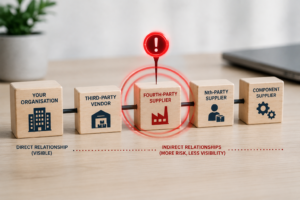
Many organisations are still struggling to manage third-party risk, yet some of the most significant threats now originate even deeper in the supply chain.
A fourth party is a supplier to one of your suppliers an organisation you may never interact with directly but whose compromise can still impact your operations, data, or security. As cloud services, software platforms, and open-source components become increasingly interconnected, these hidden dependencies are creating new visibility challenges.
F.1 When Risk Hides Beyond Your Vendors
High-profile incidents have highlighted the danger of unseen supply chain dependencies:
- SolarWinds exposed how a compromised software build process could affect thousands of organisations, even when the direct vendor had already been assessed.
- MOVEit Transfer demonstrated how a single vulnerability could ripple through supplier ecosystems, impacting organisations that were not even direct customers.
F.2 Extending Visibility Beyond Third Parties
Traditional vendor assessments alone cannot address these risks. Organisations are increasingly adopting:
- Software Bills of Materials (SBOMs)
- Supply chain mapping tools
- Vendor attestation programmes
- Contractual requirements for subcontractor transparency
While complete visibility remains difficult, the direction is clear: effective third-party risk management now requires understanding not only your vendors, but also the dependencies behind them.
-
Regulatory and Compliance Pressures Driving Change
Regulators are increasingly making organisations accountable not only for their own cybersecurity practices but also for the security of their supplier ecosystems. As a result, third-party risk management is shifting from a best practice to a regulatory requirement.
G.1 NIS2 and DORA Raise the Bar
In Europe, NIS2 requires organisations to strengthen supply chain security, assess critical suppliers, and report significant incidents, including those originating from third parties.
Meanwhile, DORA has introduced some of the most comprehensive third-party risk requirements for the financial sector. Organisations must maintain detailed records of ICT providers, conduct regular risk assessments, test operational resilience, and establish clear contractual requirements for incident reporting and supplier exit strategies.
G.2 Growing Board-Level Accountability
In the United States, the SEC’s cybersecurity disclosure rules have increased board oversight of third-party risk. Public companies must disclose material cyber incidents, including those linked to supplier compromises, making vendor risk management a matter of investor transparency as well as cybersecurity.
G.3 The Bigger Trend
Across industries and jurisdictions, the message is consistent: regulators expect organisations to actively understand, monitor, and manage supplier risk. Traditional checkbox-based vendor assessments are no longer sufficient in an environment where accountability extends across the entire supply chain.
Emerging Technologies Reshaping TPRM
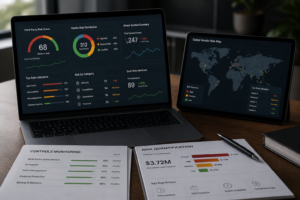
A new generation of technologies is helping organisations move beyond traditional vendor assessments and build more scalable, intelligence-driven third-party risk programmes. While these tools do not replace governance and human judgement, they significantly improve visibility across complex supplier ecosystems.
Modern security ratings platforms have evolved into comprehensive vendor intelligence solutions, combining threat intelligence, attack surface monitoring, dark web insights, and behavioral analysis to create continuously updated risk profiles. This enables organisations to identify emerging risks earlier and respond more proactively.
At the same time, attack surface management is giving organisations greater visibility into vendors’ external-facing environments, helping uncover exposed assets, vulnerabilities, and misconfigurations before they can be exploited. Continuous controls monitoring is also gaining traction by verifying that critical security controls, such as multi-factor authentication, encryption, and patch management, are operating as intended rather than relying solely on certifications or self-attestations.
Another rapidly growing area is risk quantification, which translates technical risk into potential financial impact. By expressing supplier risk in business terms, organisations can improve executive communication, support board-level decision-making, and prioritise investments more effectively. Together, these technologies are enabling a more proactive and business-focused approach to third-party risk management.
Building a Future-Ready Third-Party Risk Programme
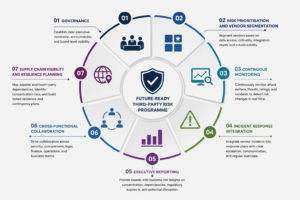
Transforming third-party risk management from a compliance exercise into an intelligence-driven function requires changes across governance, technology, and organisational culture.
I.1 Governance
Establish clear executive ownership of third-party risk. Whether led by the CISO, Chief Risk Officer, or a dedicated risk function, accountability, decision-making authority, and board-level visibility are essential. Ambiguous ownership across procurement, IT, and security often leads to fragmented risk management.
I.2 Risk Prioritisation and Vendor Segmentation
Not all vendors present the same level of risk. Organisations should segment suppliers based on factors such as data access, operational criticality, integration depth, and substitutability, ensuring oversight and monitoring efforts are focused where they matter most.
I.3 Continuous Monitoring
Annual assessments are no longer sufficient for critical vendors. Continuous monitoring of attack surface exposure, threat intelligence, security ratings, and security incidents enables organisations to identify and respond to risk changes in near real time.
I.4 Incident Response Integration
Vendor-related incidents should be fully integrated into incident response planning. Predefined communication channels, escalation procedures, and regular tabletop exercises help organisations respond more effectively when supplier breaches occur.
I.5 Executive Reporting
Boards need visibility into business risk, not compliance statistics. Reporting should focus on supplier concentration, operational dependencies, regulatory exposure, and potential business disruption rather than assessment completion rates.
I.6 Cross-Functional Collaboration
Effective third-party risk management requires collaboration across security, procurement, legal, finance, operations, and business teams. Embedding risk reviews into procurement and business processes is far more effective than treating security as a separate function.
I.7 Supply Chain Visibility and Resilience Planning
Organisations should map critical supplier dependencies, including fourth-party relationships, to identify concentration risks and single points of failure. Resilience plans, alternative suppliers, and tested contingency strategies are becoming essential components of modern third-party risk programmes.
What CISOs Should Expect Over the Next Five Years
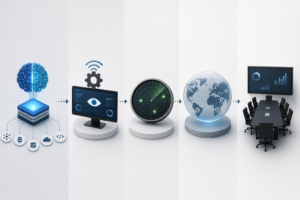
The future of third-party risk management will be shaped by four major forces: AI adoption, increasing supply chain complexity, expanding regulation, and growing board accountability. CISOs that adapt early will be better positioned to build resilient, future-ready programmes.
J.1 AI Supply Chain Risk Will Emerge
As vendors embed AI into products and operations, organisations will face a new layer of supply chain risk. Dependencies on model providers, training data sources, cloud infrastructure, and AI APIs will create additional attack surfaces that traditional vendor risk frameworks were not designed to assess.
J.2 Autonomous Monitoring Will Become the Norm
Routine vendor monitoring is increasingly being automated. As AI-driven tools mature, risk teams will spend less time gathering information and more time interpreting risk signals, making strategic decisions, and overseeing governance frameworks.
J.3 Continuous Monitoring Will Become a Requirement
Real-time risk scoring, predictive analytics, and continuous monitoring are likely to become standard expectations rather than advanced capabilities. Organisations that continue to rely primarily on periodic vendor assessments may face growing regulatory and operational pressure to modernise.
J.4 Greater Supply Chain Transparency
Customers, regulators, and investors are demanding deeper visibility into supplier ecosystems. This will accelerate adoption of supply chain mapping, Software Bills of Materials (SBOMs), and stronger disclosure requirements for subcontractors and critical dependencies.
J.5 Increasing Board-Level Accountability
Third-party risk is becoming a boardroom issue. Directors and executives are expected to understand supplier-related risks, oversee mitigation strategies, and ensure resilience across critical vendor relationships. As a result, CISOs will need to place greater emphasis on executive communication, board education, and business-focused risk reporting.
Conclusion: Intelligence, Resilience and the New Standard for Vendor Trust
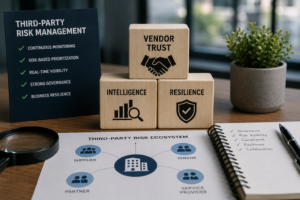
The traditional model of third-party risk management was built for a far less connected world. Annual assessments and compliance checklists may have been sufficient when supplier ecosystems were smaller and less complex, but they can no longer keep pace with today’s threat landscape.
A clear message emerged from the Gartner Security & Risk Management Summit 2026: effective third-party risk management must be continuous, intelligence-driven, and closely aligned with business resilience. Organisations need to move beyond periodic reviews and toward real-time visibility, risk-based prioritisation, and stronger oversight of their extended supplier ecosystem.
For CISOs and risk leaders, the challenge is no longer simply assessing vendors—it is understanding how supplier risk can impact business operations, regulatory compliance, and organisational resilience. Technology plays an important role, but success ultimately depends on governance, cross-functional collaboration, and informed decision-making.
The organisations best positioned for the future will be those that treat third-party risk as a strategic business issue rather than a compliance exercise. In an era of interconnected supply chains and expanding digital dependencies, trust must be continuously verified, resilience must be deliberately built, and visibility must extend far beyond direct vendor relationships.