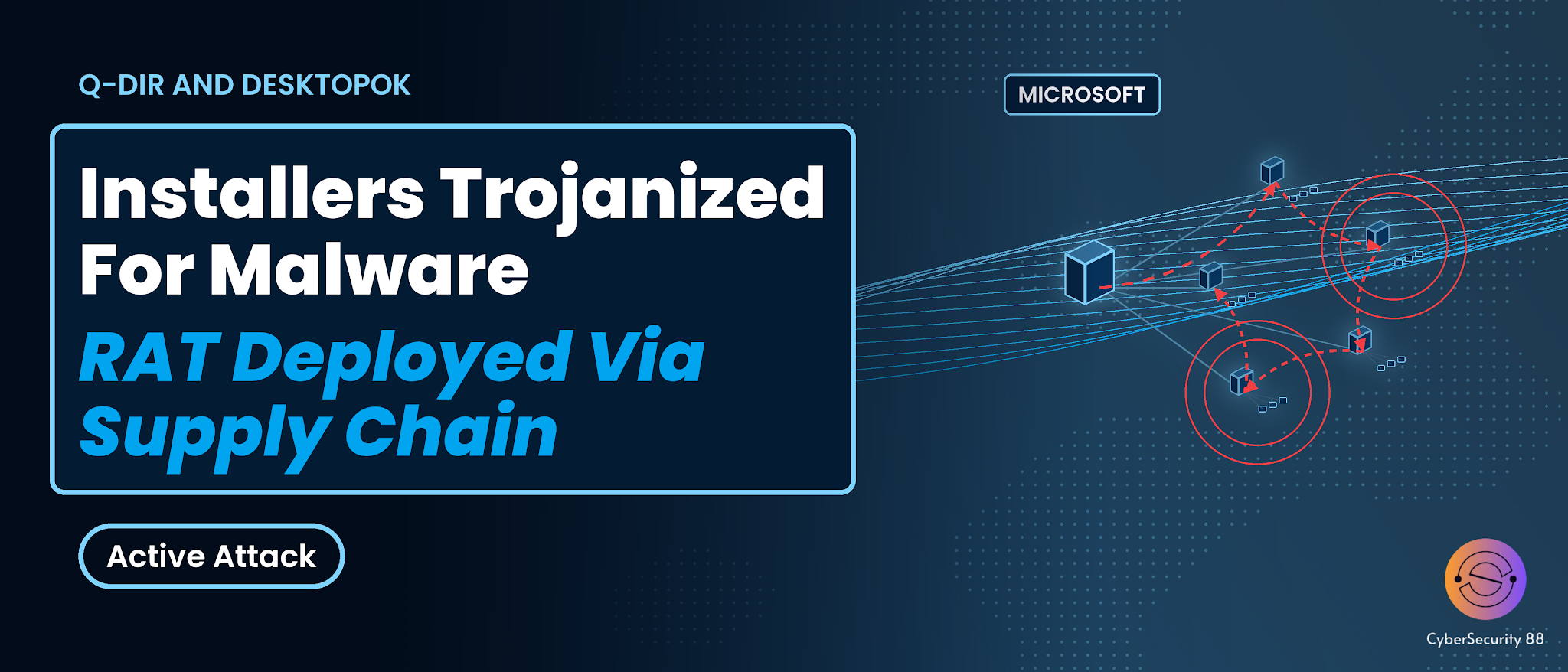
Official installation and update files for the popular Windows utilities Q-Dir and DesktopOK have been compromised in a supply chain attack to distribute a Python-based remote access trojan. On 27 November 2026, researchers disclosed that malicious files were generated when users downloaded programs directly from the official download page as well as during the update process of previously installed legitimate software. The exact mechanism that allowed the official installation files to be replaced remains unknown.
Developed by SoftwareOK, Q-Dir is a free and lightweight Windows file manager known as Quad Directory Explorer, while DesktopOK is a utility designed for saving and restoring desktop icon positions. In this supply chain incident, the malicious installer runs the legitimate application while simultaneously downloading and installing a Python remote access trojan package from an external server hosted at mail.c1a2[.]top.
The infection chain relies on the 7-Zip tool binary to extract and run the Python remote access trojan on targeted Windows systems. Persistence is achieved through a scheduled task that impersonates Microsoft Edge to execute a Python script named py_client_dsv2.py. The trojan communicates with a Command-and-Control server located at 8.210.69[.]51:9876.
South Korean cybersecurity firm AhnLab discovered the campaign, revealing that the malware features extensive capabilities. These include executing shell commands and Python code, transferring files, capturing screenshots, collecting system metadata, and gathering a list of running processes. Furthermore, the malware checks running processes against domestic and international security products and transmits this information back to the server.
Although Chinese-language comments were identified in the source code, the activity currently remains unassigned to any known threat actor. The compromise of trusted utility downloads poses significant risks to users who rely on these tools for daily file management and desktop organization, as standard installation routines effectively mask the underlying malicious activity.
Security teams should verify hash values of downloaded Q-Dir and DesktopOK files and check systems for traces of remote access trojan installation, suspicious Python execution environments, scheduled tasks, and external network communications. Administrators must note that simply uninstalling and reinstalling the program may not remove an already-installed Python trojan, making thorough system scans and antivirus engine updates essential.
Stay alert, and keep your security measures updated!
Source: Follow cybersecurity88 on X and LinkedIn for the latest cybersecurity news