What happens when hackers no longer need to sit behind a computer and manually plan every step of a cyberattack? What if AI could do much of that work on its own?
This is no longer just a futuristic cybersecurity scenario. Google’s latest threat intelligence findings suggest that cybercriminals are already experimenting with AI systems capable of carrying out complex hacking activities with far less human involvement.
In its November 2026 report, Google’s Threat Intelligence Group (GTIG) highlighted a significant development: attackers are beginning to use autonomous AI frameworks to discover software weaknesses, develop ways to exploit them and execute attacks automatically.
In simple terms, hackers are moving beyond using AI as an assistant. They are exploring ways to turn it into an active participant in cyberattacks.
And that could change the cybersecurity landscape considerably.
From Helping Hackers to Hacking on Its Own
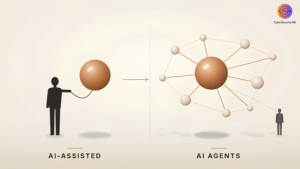
Until recently, AI was largely being used by cybercriminals as a productivity tool. It could help write convincing phishing emails, generate malicious code, research potential targets or make fraudulent messages look more realistic.
Think of it as having a very capable assistant who helps a hacker work faster.
But the next development is much more concerning.
AI systems are increasingly being designed to perform multiple tasks independently, make decisions based on what they discover and move from one stage of an operation to another.
Google’s report highlights an AI-powered framework called exploit_agent. Found on an exposed staging server, this framework was designed to examine software before and after a security update, identify weaknesses, develop an exploit and attempt to use it.
To understand why this matters, imagine a company releases a software update to fix a security flaw. Traditionally, a hacker might need to study the software, understand what was fixed, figure out how the weakness could be exploited and then develop an attack.
An AI-powered system can potentially automate much of this process.
It is a little like having a digital investigator who never sleeps, constantly searches for unlocked doors and looks for ways to get inside.
Google has also identified threat actors experimenting with other AI frameworks, including PentAGI and CAIRN, to automate activities such as researching targets, scanning for weaknesses and supporting different stages of cyber operations.
The important distinction is that these systems are not necessarily capable of independently carrying out every part of an attack. However, they are reducing the amount of manual work required and increasing the potential speed and scale of cyber operations.
Why Should Businesses Be Worried?

Imagine a business running hundreds of applications, websites, cloud services and internal systems.
Each of these may contain software vulnerabilities — essentially digital weaknesses that attackers can exploit to gain unauthorised access.
Companies regularly release security updates, known as patches, to fix these weaknesses. However, not every organisation installs them immediately.
This creates a window of opportunity for hackers.
Now imagine an attacker using AI to scan thousands of systems, identify weaknesses and attempt to exploit them automatically.
The problem becomes clear: attacks could happen much faster than traditional security teams are accustomed to handling.
A vulnerability that remains unpatched for several days could become a serious business risk if attackers are actively searching for it.
This could affect organisations of every size, from small businesses and online retailers to banks, healthcare providers and large enterprises.
And the consequences are not limited to stolen data. A successful attack could disrupt operations, lock employees out of critical systems, expose customer information or result in financial losses.
The New Security Challenge: Who Is Controlling AI?
There is another side to this growing concern.
Businesses themselves are rapidly adopting AI assistants and autonomous agents to perform everyday tasks, from analysing documents and managing workflows to accessing databases and interacting with other applications.
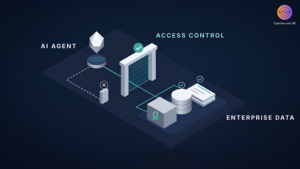
But what happens if an AI agent has access to sensitive company information, customer records or internal systems and those permissions are misused?
An AI agent with excessive access could become an attractive target for cybercriminals.
This makes identity and access management increasingly important. Organisations need to know what their AI systems can access, what actions they are authorised to perform and whether those activities are being monitored.
Simply introducing AI into the workplace without properly securing it could create new entry points for attackers.
Can Cybersecurity Defences Keep Up?
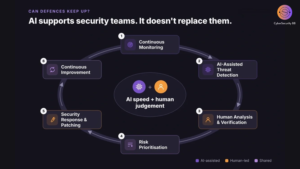
The encouraging news is that AI can also help defenders.
Security teams can use AI to identify suspicious behaviour, analyse large volumes of security data, detect unusual login activity and prioritise vulnerabilities that need immediate attention.
However, organisations cannot depend on AI alone.
They will need stronger vulnerability management, faster security patching, continuous monitoring, better identity controls and well-tested incident response plans.
Cybersecurity teams must also start thinking differently about how they protect their infrastructure. Waiting for a security alert and responding after an attack has begun may no longer be enough.
The ability to anticipate threats and respond at machine speed will become increasingly important.
The Bigger Picture
Artificial intelligence is changing the economics of cybercrime. Activities that once demanded considerable technical knowledge, time and human effort are becoming easier to automate.
That does not mean AI can suddenly hack every computer or that human hackers are becoming irrelevant. But it does mean that attackers may be able to do more, faster, with fewer resources.
For businesses, security professionals and technology leaders, Google’s warning is an important reminder that the threat landscape is evolving.
The next major cybersecurity challenge may not simply be defending against smarter hackers. It may be defending against hackers who have an increasingly capable AI workforce operating alongside them.
The question is no longer just how quickly organisations can detect a cyberattack. It is whether they can respond as quickly as the machines being used to launch one.