Amid rising tensions between India and Pakistan following the Pahalgam incident, anticipation of retaliatory action between the two nations has grown. But as cybersecurity community often warns—before the missiles fly, the cyberattacks strike. Today, the website of India’s Army Nursing College was hacked by a pro-Pakistan hacker group known as “Team Insane PK.”
 The cyberattack displayed a defaced webpage carrying messages in both Urdu and English. The attackers claimed responsibility with a bold message:
“You are hacked by Team Insane PK.”
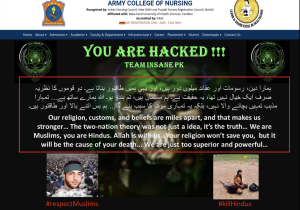
They followed it up with inflammatory remarks promoting the two-nation theory and asserting religious superiority.
This attack comes shortly after we reported that India-aligned cyber groups publicly vowed retaliation, signalling that both sides are bracing for further exchanges in cyberspace.
🚨Amid rising India🇮🇳- Pakistan🇵🇰 tensions, pro-India cyber group “Indian Cyber Force” vows retaliation in cyberspace.
Escalation may soon shift from borders to bytes👾. #CyberWarfare #IndiaPakistan #CyberConflict pic.twitter.com/tiVzc9BNMZ
— CyberSecurity88 (@CSec88) April 25, 2025
Army Nursing College: A Symbolic Target
The Army Nursing College, affiliated with the Indian Army, plays a crucial role in training nursing officers who serve in military hospitals across the country. Though not a direct military command or strategic asset, the institution represents a vital support system within India’s defense infrastructure.
By targeting such a site, the attackers likely aimed to make a symbolic statement, undermining morale and spreading panic among civilians.
Who Is Team Insane PK?
Team Insane PK has rapidly emerged as a formidable presence in the world of hacktivism, particularly targeting Indian interests. Gaining notoriety in 2022, the collective rose to prominence during the lead-up to the 2023 G20 Summit in India. Under the banner of #OpIndia, they reportedly launched over 2,450 cyberattacks, with more than half consisting of Distributed Denial of Service (DDoS) strikes.
In another high-profile operation, the group claimed responsibility for disrupting 23 Indian police department websites, affecting vital public services and disrupting communication infrastructure. Since then, their activities have grown in scale and complexity, involving data leaks and targeted messaging campaigns accusing India of various political and ideological offenses.
Is This the New Normal?
This kind of cyberattack is not unprecedented. Similar tactics have been observed before and during the Russia–Ukraine conflict, during escalations between Israel andHamas, and even in tensions between Algeria and Morocco. Experts suggest that such actions—whether state-sponsored or carried out by independent “patriotic hackers”—are becoming a new standard in modern geopolitical conflict.
In many cases, these attacks may not originate from official government sources but instead come from proxy groups or individuals aiming to create chaos or provoke further escalation.
It’s to be noted that both India and Pakistan armies are known to have dedicated cyber commands capable of launching offensive operations, making cyberspace an increasingly volatile frontier.
The Bottom Line
With this latest cyber attack on Indian army nursing college website, it’s clear that more government websites, civilian institutions, and dual-use businesses aligned with military or state interests may become targets.
It is crucial for both public and private sectors to enhance their cybersecurity posture. Regular security audits, real-time threat monitoring, and updates based on the latest threat intelligence must be prioritized.
Follow cybersecurity88 on X and Linkedin for the latest cybersecurity news